What Different Asphalt Cracks Mean in Riverside, CA
- September 13, 2026
- Riverside, CA
Types of Asphalt Cracks in Riverside, CA and What They Mean
Cracks aren’t all the same. That surprises people. A thin line running across a driveway and a patch of pavement broken into little squares might both be “cracks,” but they’re telling you two completely different stories about what’s going on underneath.
We get calls all summer from folks in Riverside standing over something in their driveway, trying to figure out if it’s a real problem or just cosmetic. Fair question. Sometimes it’s a hundred dollar fix. Sometimes it’s a sign the base gave out two years ago.
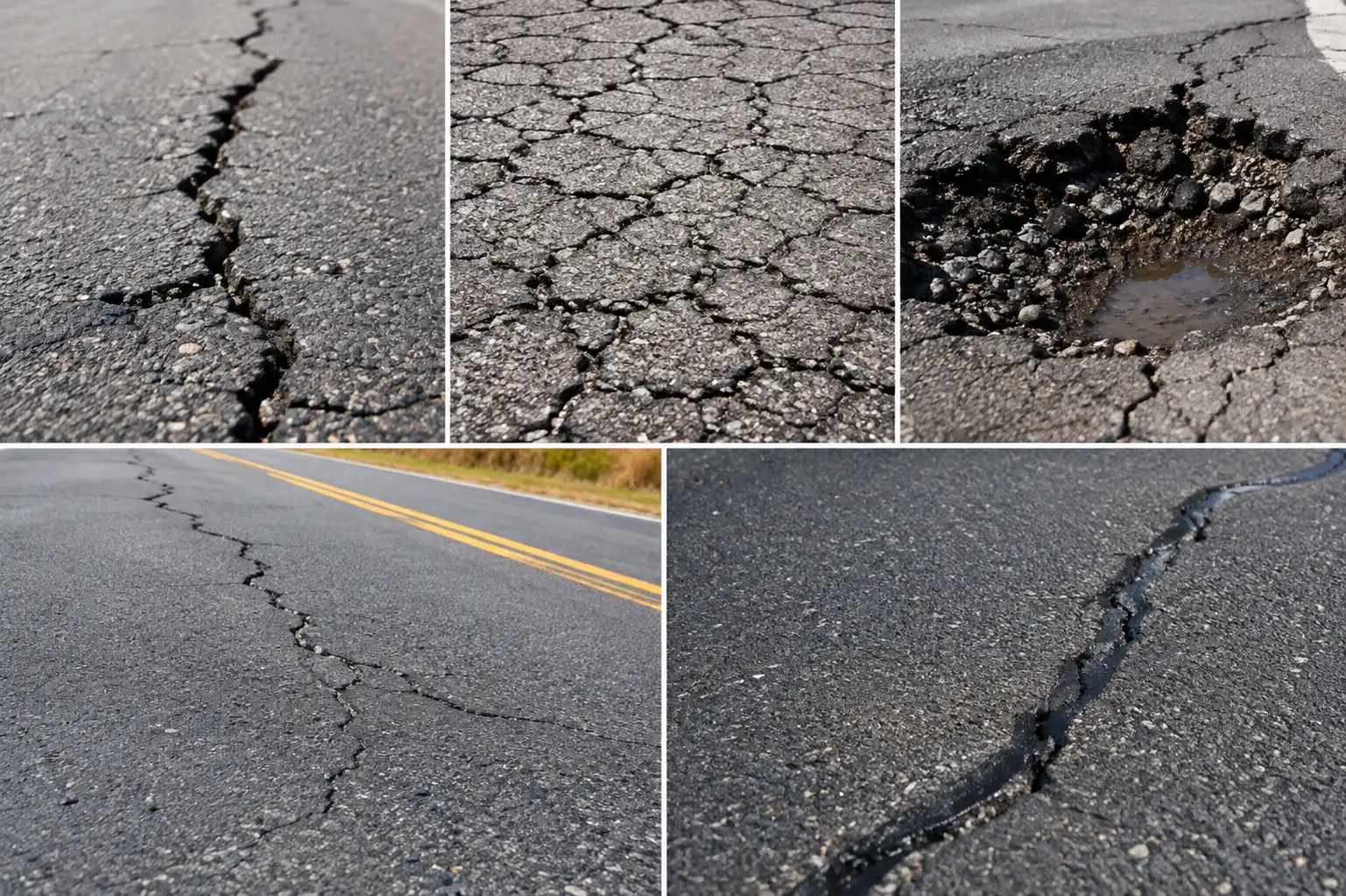
What follows is how we read them on site. Grab a photo of whatever’s bothering you and see which one it matches.
How Do I Know Which Type of Crack I Have?
Start with the pattern, not the size. The shape a crack makes usually tells you more about the cause than how wide it is.
The main ones we run into around Riverside:
- Thin, shallow lines with no clear direction
- Straight cracks running with or across the pavement
- Large squares, almost like a grid
- Small interconnected pieces, like reptile skin
- Cracking that follows the outer edge of the surface
Each one points somewhere different. Some are surface issues. Others mean the problem started below and worked its way up.
Hairline and Surface Cracks
These are the mildest ones, and usually the easiest to deal with. Thin lines, shallow, often showing up on pavement that’s been baking in the sun for several years.
They’re an aging sign more than a structural one. UV exposure and oxidation make the asphalt binder harder and less flexible over time, the surface gets brittle, and it starts to open up in small ways.
Caught early, these typically get handled with a good clean and a fresh coat of protection. This is exactly where sealcoating earns its money, because sealing a surface at this stage is far cheaper than what comes next.
Straight Cracks Running Along or Across the Pavement
Long cracks can have several causes. Longitudinal cracks may develop along construction joints, pavement edges, or areas of underlying movement. Transverse cracks often develop from temperature-related contraction as asphalt ages and loses flexibility.
The ones running lengthwise often show up along a seam where two passes of asphalt met during the original paving. Not always a defect, but a weak point that opens up eventually.
Ones running across the surface are usually about temperature. Asphalt expands in that summer heat and contracts when it cools off, and over enough cycles it splits somewhere. Sealing these matters because they’re a direct path for water into the base.
Block Cracking
Block cracking looks like a grid of large connected squares across the surface. It generally means the asphalt has hardened and lost flexibility with age, not that it’s carrying too much weight.
You’ll see it on driveways and lots that haven’t been sealed in a long stretch. The binder dried out, the surface stiffened, and it cracked as it shrank.
It’s rarely an emergency. But it’s widespread by nature, and once it covers most of a surface, patching stops making financial sense and resurfacing usually becomes the better conversation.
Alligator Cracking
This is the one to take seriously. Interconnected pieces that resemble reptile skin almost always mean the base underneath has failed and the surface no longer has proper support.
Sealing it does nothing. Patching it usually buys a season at best, because you’re covering a problem that lives below the asphalt.
In most cases the affected section needs to come out entirely so the base can be rebuilt. That’s why milling and full replacement come up in conversation when we see it spread across a parking lot.
Cracking Along the Edges
Edge cracking runs parallel to the outer boundary of the pavement, usually within a foot or so of where the asphalt stops. It typically comes from weak shoulder support or poor drainage at the perimeter.
Around here it’s often vehicles clipping the edge of a driveway where there’s nothing but dirt or grass holding it up. Water sitting along that boundary makes it worse.
The fix depends on how far in it’s traveled. Sometimes it’s a repair and a drainage correction. Sometimes the edge simply needs to be rebuilt with proper support behind it.
Why Riverside Conditions Produce These Faster
Our climate speeds up almost every one of these. Long stretches of intense sun accelerate oxidation and make the binder more brittle, which is what sets up hairline, block, and temperature related cracking in the first place.
Then the pattern reverses. A winter storm arrives, water finds every one of those openings, and the base softens where it should stay firm. When water weakens the supporting layers, repeated traffic loads can accelerate the development of alligator cracking.
Drainage is the other piece. Older parts of the city sit and drain differently than newer developments, and pavement where water pools rarely lasts as long as pavement where it moves.
What to Do Once You’ve Identified It
Deal with the small ones now, get the serious ones inspected. Most crack types are manageable while they’re still isolated, and expensive once they’ve spread.
A practical order of operations:
- Clean and fill isolated cracks before winter rain
- Seal the surface every couple of years to slow new ones forming
- Fix any spot where water sits rather than drains
- Get alligator cracking evaluated instead of patched over
- Restripe commercial lots when repairs are done
If you’re not certain which type you’re dealing with, that’s genuinely normal. Two of them look similar in early stages, and guessing wrong on that one gets costly.
Frequently Asked Questions
Can cracked asphalt be repaired, or does it need replacing?
Depends on the type. Surface and straight cracks usually seal fine. Alligator cracking generally means the base failed and needs rebuilding rather than patching.
How wide does a crack need to be before it matters?
Even narrow cracks are worth watching because they can allow water into the pavement. Wider or spreading cracks should be addressed before they become more difficult to repair.
Is DIY crack filler worth using in Riverside?
For a few isolated cracks, sure. Our summer heat breaks down cheaper store products fast, so it’s usually a short term patch rather than a real fix.
What time of year should cracks be sealed here?
Spring through fall works best. Sealing before winter rain arrives keeps water from getting into the base during the months it does the most damage.
Does crack filling stop new cracks from forming?
Not by itself. Filling handles existing damage, while sealcoating the whole surface is what slows new cracking from UV and heat exposure.
Not Sure What You're Looking At?
Send a photo or give us a call. We’ve been reading Riverside pavement for around 30 years, and most of the time we can tell you over the phone whether it’s something to watch or something to handle.
Free estimates across Riverside, Corona, Moreno Valley, Norco, Jurupa Valley, and Perris. If it turns out you just need to keep an eye on it, we’ll say that too. You can see the full range of what we handle on our asphalt and paving services page.
Trending Posts
-
 21 Oct 2026 Riverside, CAAsphalt vs Concrete Driveways in Riverside's Heat
-
21 Oct 2026 Riverside, CAHow Long Does an Asphalt Driveway Last in Riverside?
-
 20 Sep 2026 Riverside, CASealcoating vs Resurfacing: Which Does Your Lot Need?
-
 20 Sep 2026 Riverside, CAHow Thick Should a Commercial Parking Lot Be in Riverside?
-
20 Sep 2026 Orange County, CAHow Often Should Commercial Parking Lots Be Sealcoated?