
How Thick Should a Commercial Parking Lot Be in Riverside?
- September 20, 2026
- Riverside, CA
How Thick Should a Commercial Parking Lot Be in Riverside?
When you get three bids on a parking lot and one comes in noticeably cheaper, thickness is usually where the difference lives. Not in the crew, not in the equipment. In the inch or two of material nobody sees once the job is done.
That’s an uncomfortable thing about paving. The part that determines whether your lot lasts 8 years or 20 is invisible the moment it’s finished. You can’t inspect it later without cutting into it.
So it’s worth knowing the numbers before you sign anything. This covers what thickness a commercial lot actually needs, why the base matters more than the asphalt on top, and how to spot a lot that was built light.
How Thick Should a Commercial Parking Lot Be?
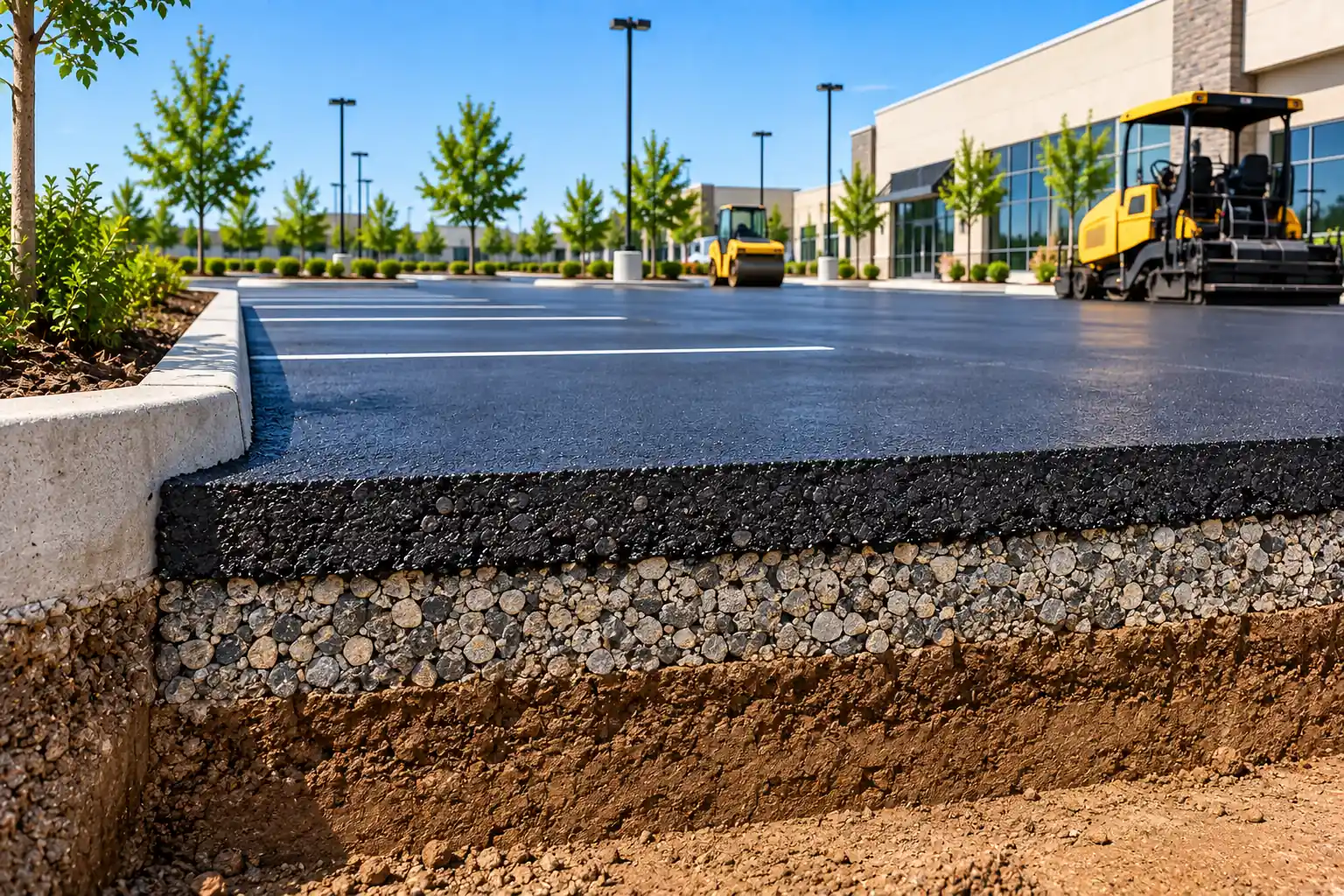
There isn’t one correct thickness for every commercial parking lot. A common starting range is about 3 to 4 inches of asphalt over 6 to 8 inches of compacted aggregate base, but the final section depends on traffic, soil strength, drainage, and site conditions.
Here’s the standard breakdown:
Lot type | Asphalt | Aggregate base |
Passenger cars only | 2 to 3 inches | 4 to 6 inches |
Mixed use with occasional delivery | 3 to 4 inches | 6 to 8 inches |
Regular truck and loading traffic | 4 to 6 inches | 8 to 12 inches |
Industrial and heavy equipment | 6 inches or more | 12 inches or more |
These are typical ranges, not a substitute for a spec. Larger projects get engineered based on a soils report and expected traffic counts.
Why the Base Matters More Than the Asphalt
The asphalt and aggregate base work together to carry and distribute traffic loads. The base provides important structural support and helps spread those loads into the subgrade.
Think of it the way you’d think about a house. The asphalt is the roof and the base is the foundation. A thicker roof doesn’t help you if the foundation is undersized.
When bids differ significantly, compare the asphalt thickness, base depth, subgrade preparation, drainage work, and other specifications line by line. A lower price can reflect a thinner pavement section or simply a different scope.
Does Compaction Matter More Than Thickness?
In a lot of cases, yes. An improperly compacted eight-inch base can perform worse than a properly compacted thinner section. Thickness matters, but so does density and uniform support.
Proper compaction means the base goes down in lifts, usually 3 to 4 inches at a time, with each layer compacted before the next one goes on. Dumping the full depth at once and rolling the top leaves everything below it soft.
The same applies to the subgrade, the native soil underneath everything. If that wasn’t prepped and compacted first, the layers above it are sitting on something that moves.
What Riverside Soil and Climate Add to the Equation
Riverside has varying soil conditions, and pavement design needs to account for the strength and moisture behavior of the site-specific subgrade. Where soils are weak or moisture-sensitive, stabilization or additional aggregate may be needed.
Two local factors that affect the spec:
- Soil type. Clay-heavy subgrade often needs extra base depth or stabilization to hold up. Sandier areas are more forgiving.
- Thermal cycling. Triple digit summers and cool nights expand and contract asphalt daily, which fatigues thin sections faster than thick ones.
A lot built to minimum spec in a mild climate on stable soil will outlast the same lot here. Building to the low end of the range in Riverside is usually a false economy.
Signs Your Lot Was Built Too Thin
Underbuilt pavement shows itself early, usually within the first 5 to 7 years instead of the 15 to 20 you paid for. The damage concentrates where the load is heaviest rather than spreading evenly.
Look for:
- Cracking that appears first in drive aisles and entrances
- Rutting or depressions in the paths trucks follow
- Soft or flexing areas under a vehicle’s weight
- Alligator cracking on a lot that isn’t very old
- Repairs that keep failing in the same spots
Age is the tell. Widespread cracking on a lot under a decade old usually points to how it was built, not to how it was maintained.
Can You Fix a Lot That Was Built Too Thin?
Yes, but the fix depends on how far along it is. If the base is still intact and only the surface has fatigued, an overlay can add structural thickness without a full rebuild.
The options, roughly in order:
- Overlay. Adds asphalt depth on a sound base, improving load capacity
- Mill and overlay. Removes the failed surface first so grade and drainage get corrected
- Full-depth repair. Rebuilds the base in the specific areas that have failed
- Reconstruction. Starts over when the base has failed across most of the lot
If you don’t know what’s under your lot, a paving contractor in Riverside, CAn core it and measure the actual layers. It takes an hour and it tells you exactly which of those four you’re looking at.
How to Protect a Lot That’s Already Underbuilt
If your lot was built light and you’re not ready to rebuild it, the goal is keeping water out and load off. Thin pavement fails fastest when those two work together.
Practical steps:
- Reroute delivery trucks off the weakest sections where you can
- Fill cracks before winter storms so water stays out of the base
- Keep drains clear so nothing pools on the surface
- Seal on a tighter schedule, closer to every 2 years
- Repair soft spots individually before they connect into larger areas
None of this adds structural capacity. It buys years, which is often exactly what you need while a capital budget catches up.
Frequently Asked Questions
Is 2 inches of asphalt enough for a commercial lot?
Only for light passenger car traffic on a well built base. Anything with delivery trucks needs 3 inches minimum, usually more.
How thick should the base be under asphalt?
Typically 6 to 8 inches of compacted aggregate for commercial lots, and 8 to 12 inches where trucks run regularly.
What happens if a parking lot is paved too thin?
It fatigues early. You’ll see cracking and rutting in the traffic lanes within a few years instead of a decade or more.
Can you add thickness to an existing lot?
Yes, through an overlay, as long as the base underneath is still sound. If the base has failed, adding surface on top won’t help.
Does Riverside soil require thicker pavement?
Often, yes. Expansive clay soils in parts of the city move seasonally, so extra base depth or stabilization is common here.
How do I know how thick my current lot is?
A core sample. A contractor drills a small plug and measures the actual asphalt and base layers, then patches the hole.
Not Sure What You're Sitting On?
If your lot is cracking earlier than it should, thickness is worth ruling in or out before you spend money on repairs that won’t hold.
We’ve been building and rebuilding Riverside lots for 30 years, and we’re happy to come out, take a look, and tell you whether you’ve got a maintenance problem or a construction one. Estimates are free either way.
Trending Posts
-
 20 Sep 2026 Riverside, CASealcoating vs Resurfacing: Which Does Your Lot Need?
 -
 20 Sep 2026 Riverside, CAHow Thick Should a Commercial Parking Lot Be in Riverside?
 -
 20 Sep 2026 Orange County, CAHow Often Should Commercial Parking Lots Be Sealcoated?
 -
 20 Sep 2026 Orange County, CAWhat Is the Difference Between Asphalt Repair, Resurfacing, and Replacement?
 -
 14 Sep 2026 Riverside, CAHow Long Does Asphalt Last in Riverside, CA?