
Sealcoating vs Resurfacing: Which Does Your Lot Need?
- September 20, 2026
- Riverside, CA
Sealcoating vs Resurfacing: Which Does Your Lot Need?
Every property owner in Riverside eventually gets two very different quotes for what looks like the same problem. One contractor says seal it. The next one says it needs resurfacing. The prices aren’t close, and now you’re stuck guessing which one was being straight with you.
Here’s the thing. They might both be right, depending on what’s actually happening under that surface.
Sealcoating and resurfacing solve different problems. One protects asphalt that’s still structurally fine. The other replaces asphalt that isn’t. Picking wrong in either direction costs you money, either by paying for work you didn’t need or by paying twice for work that didn’t hold.
This walks through the difference, how to tell which side your lot falls on, and the signs that mean neither option is going to help.
What’s the Difference Between Sealcoating and Resurfacing?
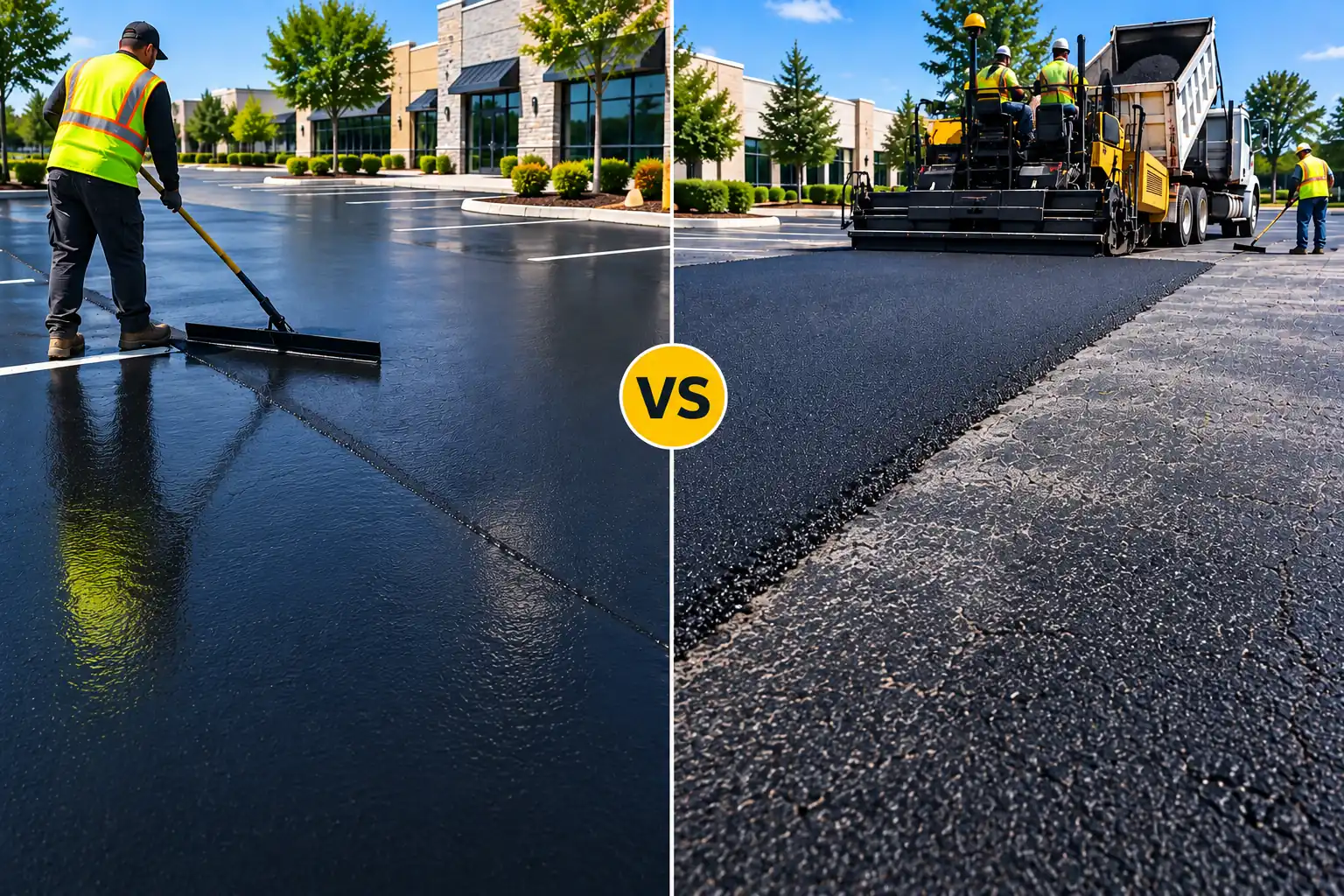
Sealcoating applies a protective coating over existing asphalt. Resurfacing, often called an asphalt overlay, adds a new asphalt surface over a prepared existing pavement, sometimes after milling the old surface.
Sealcoating | Resurfacing | |
What it does | Coats and protects the surface | Replaces the top layer of asphalt |
Thickness added | Roughly 1/8 inch | Typically 1.5 to 2 inches |
Fixes cracks? | No, only seals fine ones | Yes, on a sound base |
Lasts | 2 to 3 years | 8 to 15 years |
Downtime | A day or two | Several days |
The short version: sealcoating buys time on good asphalt. Resurfacing gives you a new surface on a base that’s still doing its job.
When Sealcoating Is the Right Call
Sealcoat when the asphalt is structurally sound and you’re trying to keep it that way. If your lot drains properly, has no soft spots, and only shows fading with a few thin cracks, sealing is the smart, cheap move.
Signs you’re in sealcoating territory:
- Surface looks gray or washed out instead of dark
- Cracks are hairline or narrow, and they’re isolated
- No standing water after rain
- Nothing feels soft or spongy when you drive over it
- The asphalt has cured sufficiently and has never been sealed
One of the highest-value maintenance steps you can take for sound asphalt is regular sealcoating. It’s a small expense that pushes the big one out by years.
When Resurfacing Is the Right Call
Resurface when the surface is worn out but the base underneath is still solid. That’s the whole test. If what’s under the asphalt is stable, you don’t need to tear the lot out, you just need a new driving surface on top.
You’re likely looking at resurfacing if:
- Cracking is widespread rather than isolated
- The surface is raveling, meaning loose aggregate is coming up
- Old patches and repairs have made the lot uneven
- Sealcoating has been done a few times and no longer holds
- The asphalt is 15 to 20 years old and looks its age
Most Riverside commercial lots hit this point once. It’s a normal lifecycle event, not a sign anyone did anything wrong.
When Neither One Is Going to Work
If the base has failed, both options are a waste of money. Resurfacing over a bad base gives you a nice looking lot that cracks through in a season or two, and sealcoating over it does even less.
The tell is alligator cracking, that web of interconnected cracks that breaks the asphalt into small pieces. It indicates structural fatigue, often associated with inadequate pavement thickness, weak supporting layers, moisture damage, or repeated heavy loading.
When that shows up, the fix is a full-depth repair on those sections, or reconstruction if it’s spread across the lot. Any crew that offers to just seal over it is selling you a season.
How Riverside’s Climate Changes the Timeline
Asphalt here ages faster than the standard maintenance schedules assume, because UV does most of the damage before rain ever gets a chance. Triple digit summers dry out the binder that holds the surface together, and a lot can go brittle years before it looks worn.
That has a practical effect on both options:
- Sealcoating intervals run shorter here, closer to 2 years than 3 on lots with heavy sun exposure
- Unsealed asphalt reaches the resurfacing conversation noticeably early
- The window to seal before winter storms arrive is roughly now through October
A lot that’s never been sealed in Riverside is usually further along than the same lot would be in a milder climate.
What Each Option Costs You Over Ten Years
The cheapest path over a decade is almost always consistent sealcoating, not skipping it. Sealing is a small recurring expense. Resurfacing is a large one-time expense, and reconstruction is a much larger one.
Rough picture for a typical commercial lot:
Approach | What you spend over 10 years |
Seal every 2 to 3 years | Several small maintenance costs |
Skip sealing, resurface at year 8 | One large repair cost |
Skip everything, rebuild the base | The largest cost of the three |
Deferring maintenance doesn’t save money, it just moves the bill and adds interest. That’s the part that catches property managers off guard when a budget cycle comes around.
How to Stay in Sealcoating Territory
Keeping a lot in the cheap category comes down to water and timing. Seal on schedule, and don’t let cracks stay open through a rainy season.
A workable rhythm:
- Walk the lot after the first real rain each winter and note where water sits
- Fill new cracks before storm season, not after
- Keep drains and gutter lines clear of debris
- Seal every 2 to 3 years depending on sun and traffic
- Get eyes on any soft spot early instead of watching it another year
The crew we send out handles both sealcoating and resurfacing, which honestly matters here, because a company that only sells one of them tends to find that one everywhere they look.
Frequently Asked Questions
Can you sealcoat a parking lot that’s already cracked?
Fine hairline cracks, yes. Wide cracks need filling first, and alligator cracking needs real repair. Sealing over structural damage just hides it temporarily.
How often should a Riverside lot be sealcoated?
Every 2 to 3 years for most commercial lots. Heavy sun exposure and constant traffic push it toward the shorter end of that range.
Is resurfacing cheaper than replacing a parking lot?
Considerably. Resurfacing reuses the existing base, so you’re paying for a new surface instead of a full rebuild, provided that base is still sound.
How long does resurfaced asphalt last?
Typically 8 to 15 years, depending on traffic and whether it gets sealed. Skipping maintenance after resurfacing pulls that number down quickly.
Can I sealcoat right after resurfacing?
No, new asphalt needs to cure first, usually somewhere between 3 and 6 months. Sealing too early traps oils and causes problems.
What time of year is best for either job?
Late spring through early fall. Both need warm, dry conditions to cure properly, and you want it done before winter storms arrive.
Still Not Sure Which One You Need?
The honest answer is that you can usually narrow it down from your own parking lot in about five minutes. Look for standing water, soft spots, and that web-pattern cracking. Any of those and you’re past sealcoating.
If you’d rather have someone confirm it, we’ll come out and look. We’ve been working on Riverside pavement for 30 years, and we’ll tell you if sealing is all you need, even though it’s the smaller job. Estimates are free.
Trending Posts
-
 20 Sep 2026 Riverside, CASealcoating vs Resurfacing: Which Does Your Lot Need?
 -
 20 Sep 2026 Riverside, CAHow Thick Should a Commercial Parking Lot Be in Riverside?
 -
 20 Sep 2026 Orange County, CAHow Often Should Commercial Parking Lots Be Sealcoated?
 -
 20 Sep 2026 Orange County, CAWhat Is the Difference Between Asphalt Repair, Resurfacing, and Replacement?
 -
 14 Sep 2026 Riverside, CAHow Long Does Asphalt Last in Riverside, CA?