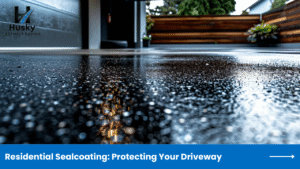
Is your asphalt driveway losing its dark sheen and showing early wear? Over time, UV rays, moisture, petroleum stains, and freeze–thaw cycles degrade asphalt surfaces. This guide covers every aspect of residential sealcoating—from benefits and sealant selection to DIY vs. professional application and post‑sealcoat upkeep. Learn how Husky Asphalt Paving’s specialized sealcoating services can extend your pavement’s life and enhance curb appeal.
Key Takeaways
- Sealcoat your driveway every two to three years for maximum pavement life.
- Choose polymer‑modified emulsion for best UV and abrasion protection.
- Proper surface prep and crack sealing ensure a uniform, long‑lasting coat.
- Professional application includes warranty and high‑capacity equipment benefits.
- Regular post‑sealcoat inspections and gentle cleaning preserve the protective layer.
What does residential sealcoating achieve for your driveway?

Residential sealcoating restores the original color, fills micro‑pores, and creates a protective layer that resists water penetration, petroleum spills, and UV oxidation. By applying an asphalt emulsion sealer, homeowners can reduce surface abrasion by up to 70%, according to the National Asphalt Pavement Association (2021). This barrier also slows oxidation, preventing cracks and potholes from expanding over time.
Sealcoating replenishes fine oils lost to sun and rain, restoring flexibility to an asphalt driveway. When Husky Asphalt Paving applies its proprietary hot‑applied mastic sealant, pavement maintenance intervals can extend from two to four years, depending on climate and traffic load. This protective coat also repels deicing salts, reducing corrosion along edges and expansion joints.
Enhance pavement with Husky Asphalt Paving’s sealcoating to lock in moisture resistance and maintain a uniform surface texture. Regular sealing prevents root intrusion beneath cracks and minimizes erosion along gravel perimeters. The result is a driveway that looks new longer and carries a manufacturer’s warranty against peeling and flaking for up to 24 months.
The next section will help you spot early warning signs that your driveway needs preventive sealcoating.
What are the signs that your driveway needs home sealcoating?

Cracks, fading color, and surface pitting signal that sealcoating is overdue. When asphalt turns light gray or exhibits spiderweb patterns, UV‑induced oxidation has dried out binder oils. Husky Asphalt Paving recommends resealing before micro‑cracks widen beyond 1/8 inch to avoid deeper base damage.
Pooling water on depressions, sand‑like grit on the surface, and oil stains absorbing into asphalt all point to weakened pavement. In climates like Minnesota’s freeze–thaw cycle, moisture trapped in cracks expands, leading to spalling. Early resealing can prevent potholes and save up to 40% in full overlay costs.
Additional red flags include edge deterioration near grass and block paving driveways, surface flaking after snowplow use, and frequent need for cold patch asphalt repair. Homeowners who avoid these warning signs often face more extensive driveway pavement repair later. Recognizing these issues early allows Husky Asphalt Paving to schedule timely maintenance.
Up next, discover the core benefits of routine driveway maintenance via sealcoating.
What are the key benefits of regular driveway maintenance through sealing?

Consistent sealcoating dramatically improves pavement longevity, surface safety, and aesthetic appeal. By preventing water ingress and binder oxidation, a single coat can extend a driveway’s service life by up to 50%. This translates into fewer potholes, reduced erosion, and minimal need for patching.
Regular sealing also enhances traction by filling minor voids, making driving safer in wet or icy conditions. Husky Asphalt Paving’s seal coat includes traction‑enhancing additives that meet American Association of State Highway and Transportation Officials (AASHTO) guidelines for skid resistance.
Financially, resealing reduces overall driveway maintenance costs by lowering the frequency of crack sealing, pothole repair, and full resurfacing. Homeowners report saving $500–$1,200 over a ten‑year span when comparing routine sealcoating versus reactive repairs. Visually, sealcoated driveways boost curb appeal, which can raise property value by as much as 5%, according to the Appraisal Institute.
Learn how to choose the ideal sealant formulation for your specific asphalt care needs in the following section.
How do you select the right sealant for your residential asphalt?

Choosing between asphalt-based, coal tar emulsion, and polymer-modified sealants depends on traffic load, climate, and environmental regulations. Asphalt emulsions suit light‑traffic residential driveways, while coal tar formulas offer superior oil‑resistance for driveways exposed to gasoline leaks. Polymer-enhanced sealers deliver longer wear and enhanced UV protection in high‑sun regions.
Husky Asphalt Paving uses an environmentally friendly polymer blend that meets Pennsylvania Department of Environmental Protection (PA DEP) VOC limits. This proprietary emulsion provides a 0.10‑inch thick coat per application, covering 100–120 square feet per gallon. The company’s crack‑bridging formula also resists tree root intrusion at expansion joints.
When ordering a free estimate, homeowners should consider coverage rates, dry‑time (typically 24–48 hours), and recoat windows (usually 1–3 hours between coats). For driveways in freezing climates, a sealer with liquid anti‑freeze additives extends the application season into early spring and late fall.
Refer to the comparison table below for a quick overview of Husky Asphalt Paving’s most popular sealant options.
Below is a detailed comparison table summarizing key attributes of sealant types offered by Husky Asphalt Paving.
| Sealant Type | Primary Composition | Coverage (ft²/gal) | Recommended Recoat Interval | Key Benefit |
|---|---|---|---|---|
| Polymer-Modified Emulsion | Asphalt + Styrene-Butadiene | 100–120 | 2–3 hours | Enhanced UV & abrasion resistance |
| Coal Tar Emulsion | Coal tar + emulsifier | 90–110 | 3–4 hours | Superior oil and gasoline repellent |
| Asphalt Emulsion | Asphalt binder + water | 110–130 | 1–2 hours | Eco‑friendly, low VOC |
| Hot-Applied Mastic | Rubberized asphalt | 80–100 | N/A (single coat) | Crack filling & high durability |
This table highlights how Husky Asphalt Paving’s sealants differ in composition, coverage, and performance. Selecting the right option ensures optimal protection against moisture, petroleum, and UV degradation.
Next, see how to prepare your driveway surface for a flawless sealcoat application.
How do you prepare your driveway for optimal sealcoating results?

Surface preparation begins with pressure washing to remove dirt, oil, and vegetation. A clean surface allows sealant to bond directly to aggregate and binder, preventing early peeling. Husky Asphalt Paving uses 3,000‑psi hot‑water washers to clear residual salts and algae.
After drying for 24 hours, technicians perform crack sealing using asphalt crack filler or hot‑applied mastic. Filling cracks wider than 1/8 inch and sealing edge joints stops moisture infiltration. Expansion joints should also receive specialized sealant to protect against freeze–thaw cycles.
Driveway pavement repair near me often starts with pothole patching using cold patch asphalt or full‑depth repairs for larger voids. Once repairs cure for 48 hours, the surface is ready for final sweeping and tack coat application if needed. Proper prep ensures Husky Asphalt Paving’s sealcoating adheres and cures evenly.
We’ll now walk through the detailed step-by-step sealcoat application process.
What is the step-by-step home sealcoating application process?

The sealcoating application process begins with a final inspection and masking off curbs, garage doors, and landscape beds. Husky Asphalt Paving then applies a tack coat to ensure adhesion. Next, sprayers or squeegees lay down the first uniform sealcoat layer at 0.08–0.10 inches thick.
After a 2–4 hour dry interval, a second coat is applied if specified. Fine‑grade sand is broadcast into the wet sealer to improve traction. For hot‑applied mastic sealant, only one coat is needed to fill surface voids and cracks.
Curing time ranges from 24 to 48 hours, depending on temperature and humidity. Husky Asphalt Paving provides traffic cones and safety signage during this period. Once cured, the driveway is swept to remove loose sand, and line striping or decorative stenciling can be performed as a final enhancement.
The following section compares professional application versus DIY maintenance.
What are the differences between professional sealcoating application and DIY driveway maintenance?

Professional sealcoating by a certified crew ensures consistent sealer thickness, correct mixing ratios, and adherence to environmental regulations. Husky Asphalt Paving’s technicians achieve uniform coverage—and meet DEP VOC standards—whereas DIY homeowners often under‑ or over‑apply, leading to uneven curing or wasted material.
Professionals use commercial‑grade equipment—hot water pressure washers, pneumatic crack sealers, and high‑capacity sprayers—yielding faster turnaround and more durable results. In contrast, a homeowner’s garden‑hose sprayer and hand squeegee may leave missed spots or streaking that accelerates wear.
Warranty coverage is another major difference: Husky Asphalt Paving offers a 24‑month workmanship guarantee, covering peeling or flaking, which is not available with DIY kits. While DIY sealers cost $0.10–$0.15 per square foot, professional service ranges from $0.30–$0.45 per square foot but includes prep, cleanup, and detailed crack repair.
Up next, learn how to keep your newly sealed driveway in top condition.
How do you maintain your driveway after residential sealcoating?

Post‑sealcoat maintenance consists of gentle washing and periodic inspections. Use a mild detergent and sled pressure (<1,200 psi) to remove dirt without abrading the sealer layer. Avoid oil‑based cleaners that soften sealcoat binder and strip away polymers.
Inspect for new cracks or sand depletion every six months. Hairline cracks should be resealed with a spray‑grade crack filler to prevent seepage. Light broadcast applications of traction sand can refresh surface grip without requiring a full recoat.
Keep vehicles free of leaks by checking for oil or gasoline drips. Petroleum exposure can soften the sealer, creating sticky patches. Husky Asphalt Paving offers complimentary touch‑up crack sealing within 12 months of service under its maintenance plan.
Your driveway is now properly protected and maintained with Husky Asphalt Paving’s expert sealcoating services.
How often should I sealcoat my residential driveway?
Sealcoat driveways every two to three years, depending on traffic and climate exposure.
Can I drive on a newly sealcoated driveway?
Light foot traffic is allowed after 6–8 hours; wait 24–48 hours for vehicles.
What is the best season for sealcoating?
Late spring to early fall offers ideal temperatures (50–85°F) and low humidity.
How long does sealcoat take to cure?
Curing usually completes in 24–48 hours; dry time depends on weather conditions.
Does sealcoating prevent potholes?
Sealcoating helps prevent potholes by blocking moisture and UV oxidation.
Residential sealcoating stands as an essential investment to protect and beautify asphalt driveways against moisture, UV degradation, and petroleum damage. Husky Asphalt Paving’s tailored sealants and industry‑grade application ensure durable results backed by a 24‑month warranty. Consistent maintenance, including gentle washing and crack monitoring, further extends service life and safety. With professional sealcoating, homeowners secure both aesthetic appeal and long‑term cost savings.

